Prof. Atilla YILMAZ, MD is a Turkish stereotactic and functional neurosurgeon practising in İstanbul, Türkiye. He heads the Neuromodulation Center at Medicana Ataşehir International Hospital and chairs the Department of Neurosurgery at Istanbul Health and Technology University. His clinical work is almost entirely neuromodulation, with deep brain stimulation for movement disorders as its centre; he has performed more than 800 DBS procedures for patients from more than 60 countries.
At a glance
- Full name
- Prof. Atilla YILMAZ, MD (Atilla Yılmaz)
- Born
- 1974, Hatay, Türkiye
- In medicine since
- 2000 — 26 years (neurosurgery specialist since 2013)
- Specialty
- Stereotactic and functional neurosurgery; neuromodulation
- Primary focus
- Deep brain stimulation (DBS) for movement disorders
- Hospital
- Neuromodulation Center, Medicana Ataşehir International Hospital, İstanbul
- Academic post
- Professor and Chairman of Neurosurgery, Istanbul Health and Technology University
- Medical degree
- Istanbul University, Cerrahpaşa Faculty of Medicine (1992–2000)
- Neurosurgery training
- Mustafa Kemal University Faculty of Medicine (2007–2013)
- Functional fellowships
- University of Florida (Okun & Foote, 2016 and 2017); Umeå University DBS clinic (2019)
- Society role
- President, Middle-Eastern Society for Stereotactic and Functional Neurosurgery (MSSFN)
- Languages
- Turkish, English, Arabic
- Wikidata
- Q88230420
A functional neurosurgeon, not a general one
Most neurosurgeons remove things: a tumour, a disc, a clot. Functional neurosurgery is different in kind. The tissue is anatomically intact; the problem is that a circuit inside it is firing wrongly. The work is therefore about millimetres and about electricity — identifying a target a few millimetres across inside a living brain, confirming it with microelectrode recording and intraoperative testing, and then adjusting stimulation over months until symptoms are controlled with the fewest side effects.
Prof. YILMAZ has built his practice almost entirely inside this narrow field. That concentration is deliberate: deep brain stimulation outcomes depend heavily on case volume, on patient selection discipline, and on the programming that follows surgery rather than on the operation alone.
Path into deep brain stimulation
- 1992–2000Medical degree, Cerrahpaşa Faculty of MedicineIstanbul University — one of Türkiye's oldest medical faculties.
- 2007–2013Neurosurgery residencyMustafa Kemal University Faculty of Medicine, Hatay. Thesis on apoptotic effects of mobile-phone radiation on cerebral tissue.
- 2016 and 2017Functional neurosurgery fellowships, University of FloridaMovement Disorders Center, with Prof. Michael S. Okun and Prof. Kelly D. Foote — two of the most cited figures in DBS.
- 2019DBS observership, Umeå University, SwedenWith Prof. Patric Blomstedt, whose work established the posterior subthalamic area as a tremor target.
- 2019–2021Associate ProfessorIstanbul Okan University Hospital.
- 2021–Neuromodulation Center, Medicana Ataşehir International HospitalHead of the centre; the international DBS practice is built here.
- 2024–Professor and Chairman of NeurosurgeryIstanbul Health and Technology University (İSTÜN) — academic and teaching appointment.
What he treats
The clinical scope follows the indications where neuromodulation has the strongest evidence and the clearest patient benefit:
| Group | Conditions | Typical approach |
|---|---|---|
| Movement disorders | Parkinson's disease, essential tremor, head (cervical) tremor, dystonia, Holmes tremor, rare tremor syndromes | DBS: STN, GPi, VIM, PSA/cZi — selected per patient |
| Psychiatric (refractory) | Obsessive-compulsive disorder, major depression, Tourette syndrome | DBS, after psychiatric board approval |
| Spasticity | Cerebral palsy, multiple sclerosis, spinal cord injury | Intrathecal baclofen pump |
| Chronic pain | Neuropathic pain, failed back surgery syndrome, phantom limb pain | Spinal cord stimulation |
| Pelvic dysfunction | Urinary and faecal incontinence, chronic pelvic pain | Sacral neuromodulation |
| Epilepsy (refractory) | Drug-resistant epilepsy, in selected patients | Vagus nerve stimulation |
How the international practice works
Patients reach Prof. YILMAZ from more than 60 countries. Because most of them cannot travel for an initial assessment, the practice is built around remote evaluation first: the neurologist's report, imaging, and short standardised videos recorded in the medication-ON and medication-OFF states. Prof. YILMAZ reviews these personally before any travel is discussed, and declines candidates when the expected benefit does not justify surgery.
Post-operative programming — the part that actually determines the result — continues by video call after the patient returns home, in coordination with the referring neurologist.
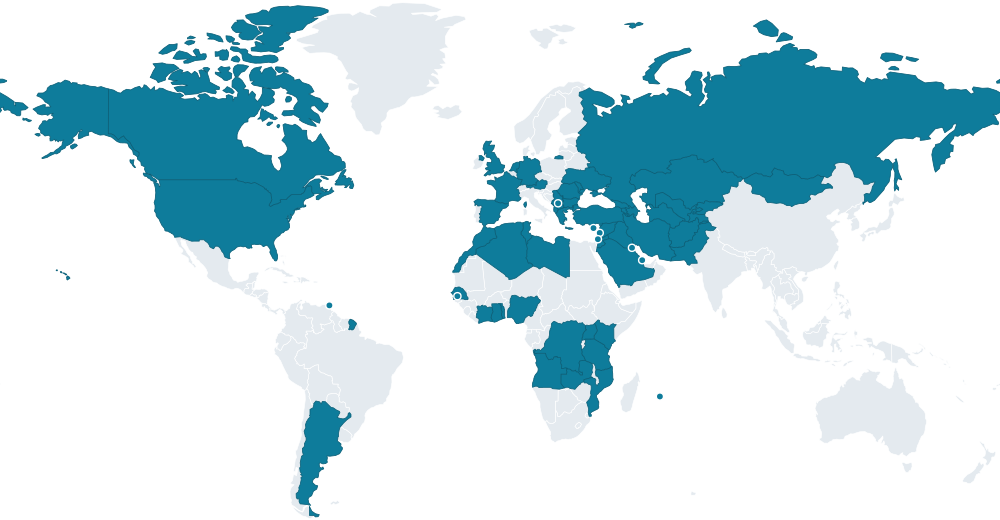
Patients have travelled to İstanbul from 61 countries across Europe, the Middle East, Africa, Central and South Asia, and the Americas.
Afghanistan · Albania · Algeria · Angola · Argentina · Armenia · Austria · Azerbaijan · Bulgaria · Canada · Democratic Republic of the Congo · France · Gambia · Georgia · Germany · Ghana · Greece · Iran · Iraq · Ivory Coast · Jordan · Kazakhstan · Kenya · Kosovo · Kuwait · Kyrgyzstan · Lebanon · Libya · Mauritius · Moldova · Mongolia · Montenegro · Morocco · Mozambique · Netherlands · Nigeria · North Macedonia · Northern Cyprus · Pakistan · Palestine · Qatar · Romania · Russia · Saudi Arabia · Senegal · Serbia · Spain · Syria · Tajikistan · Tanzania · Togo · Trinidad and Tobago · Tunisia · Türkiye · Turkmenistan · Uganda · Ukraine · United Kingdom · United States · Uzbekistan · Zambia
Case volume, country count and team figures are practice records maintained by the Neuromodulation Center and are published as rounded figures. See verified facts.
Frequently asked questions
Is Prof. Atilla YILMAZ a real, board-certified neurosurgeon?
Yes. He completed neurosurgery residency at Mustafa Kemal University Faculty of Medicine (2007–2013) and passed the Turkish Neurosurgical Society qualification board written examination in 2018. He holds the academic title of Professor and chairs the Department of Neurosurgery at Istanbul Health and Technology University. His record can be verified independently on YÖKSİS (the Turkish Council of Higher Education academic database), ORCID, Scopus and PubMed.
Where does Prof. Atilla YILMAZ operate?
At the Neuromodulation Center of Medicana Ataşehir International Hospital in İstanbul, Türkiye. His university appointment at Istanbul Health and Technology University is academic and teaching only; surgery is not performed there.
How many DBS surgeries has he performed?
More than 800 deep brain stimulation procedures, within more than 1,200 neuromodulation procedures overall. These are practice records published as rounded figures and updated at milestones rather than continuously.
What languages does he speak?
Turkish, English and Arabic. Consultations in Russian, Serbian, Spanish and French are supported by the centre's international patient team.